
What is selective laser trabeculoplasty?
Selective laser trabeculoplasty is a painless laser treatment that lowers the pressure inside your eye. It works on the eye’s natural drainage channel, called the trabecular meshwork, gently stimulating it so that fluid drains away more efficiently and the pressure falls.
The word selective describes how the laser targets only specific pigmented cells in the drainage tissue, leaving the surrounding structures unharmed, which is why the treatment is so gentle and can be safely repeated. SLT is commonly used for open-angle glaucoma and for a related condition called ocular hypertension, where the pressure is raised but damage has not yet occurred. It has become an increasingly popular first-line option because good evidence shows it can control pressure effectively while reducing reliance on daily drops, which many people find easier to live with. It does not suit every type of glaucoma, and it is not always a complete substitute for other treatment, but for suitable patients it is a safe and effective way to lower pressure. Your consultant will confirm whether your glaucoma is the kind that responds well to this approach. Clinical studies demonstrate that approximately 70–80% of patients achieve a meaningful reduction in intraocular pressure, potentially delaying or reducing the burden of daily drop regimens.
What SLT involves
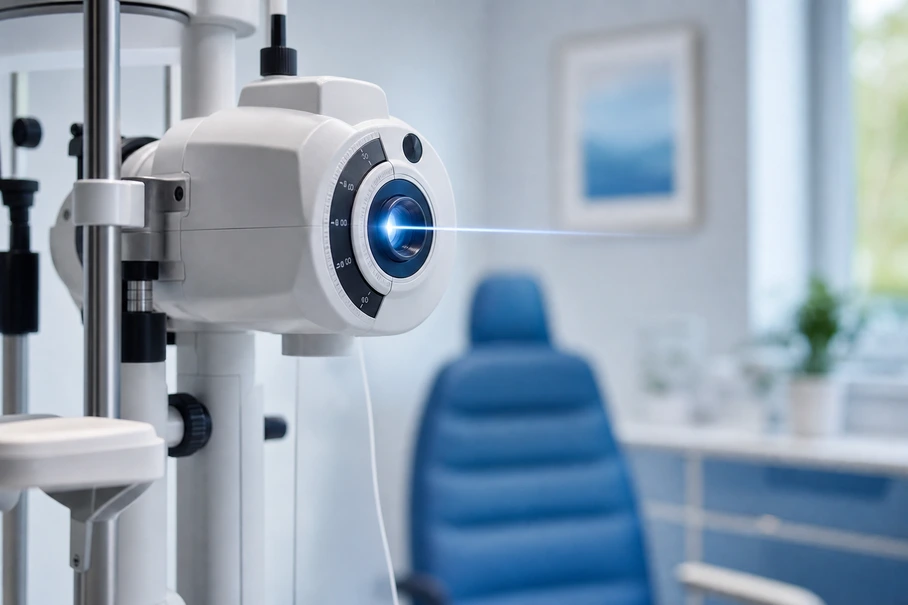
A gentle laser is applied to the eye’s natural drainage channel to help fluid drain more freely. The treatment is carried out in the clinic in Yeovil while you sit at a machine much like the one used for an eye examination, with your chin and forehead supported. Numbing drops are placed in the eye first, and a special contact lens is used briefly to direct the laser precisely onto the drainage tissue.
The treatment takes only a few minutes per eye and is not painful, though you may notice flashes of light from the laser and a little awareness of the lens on the eye. There are no incisions and no needles, and you remain seated and comfortable throughout. Afterwards, your eye pressure is usually checked, and you can return home the same day. The pressure-lowering effect develops gradually over the following weeks rather than immediately, and your consultant will arrange a follow-up to measure how well it has worked. If needed, SLT can be repeated in the future, which is one of its advantages over some other treatments.
What to expect on the day of your SLT
- Drops to numb the eye and prepare it
- You sit at the laser as for an eye examination
- A few minutes of painless treatment per eye
- Home the same day, back to normal quickly
SLT benefits and considerations
SLT is effective for many patients and can treat both eyes without incisions or daily drops, making it a convenient option that fits easily into everyday life. Because it can reduce or delay the need for glaucoma medication, it is particularly helpful for people who find drops difficult to use or who would prefer to avoid them. It is also repeatable, so its benefit can often be renewed if the effect fades.
There are some considerations to weigh. The pressure-lowering effect can lessen over time, so SLT may need repeating after a few years, and it does not work for everyone or for every type of glaucoma. Some people experience mild inflammation or a short-lived rise in pressure just after treatment, which your consultant will monitor and manage. SLT is often one part of a broader plan, and it may be combined with drops or other treatments to keep your pressure in a safe range. Your consultant will confirm whether it is right for you and will not guarantee a specific result, but for many people in Yeovil it offers a gentle and effective way to protect their sight. A consultation is the best way to find out whether SLT suits your glaucoma. According to a study, SLT has been shown to reduce intraocular pressure by about 20% in many patients (NICE).

Ms Brinda Shah
Consultant Ophthalmologist
Quick facts
Anaesthetic
Drops
Duration
A few minutes per eye
Stay
Outpatient
Recovery
Same day