
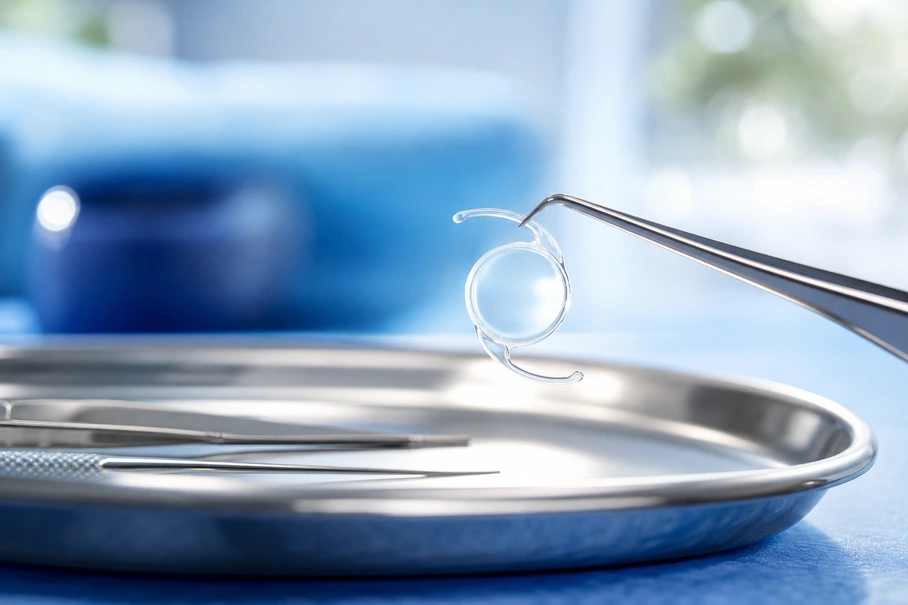
What is premium lens cataract surgery?
Premium lens cataract surgery replaces your clouded lens with an advanced intraocular lens that corrects more of your vision than a standard lens. A standard, or monofocal, lens gives excellent vision at one distance, usually far away, so reading glasses are still needed. A premium lens is designed to do more.
The main premium options are toric lenses, which correct astigmatism so that images are sharper without the blur that an unevenly shaped cornea can cause; and extended depth of focus, or EDOF, lenses, which give a smooth range of vision from distance to intermediate. The right choice depends on the health of your eyes, the shape of your cornea, and how you spend your time, whether that is driving, using screens, reading or a mix of everything. Premium lenses are a good option for many people, but they are not suitable for every eye, and your consultant will explain honestly whether your eyes are well matched to them. This careful, individual assessment is central to getting a result you are happy with.
What premium lens surgery involves
The clouded lens is removed and replaced with the premium lens best matched to your eyes and daily activities, using the same gentle small-incision technique as standard cataract surgery. Before the operation, detailed measurements and scans of your eye are taken so the lens power and type can be selected precisely, and Ms Brinda Shah discusses each option with you, weighing the benefits and the trade-offs.
The surgery itself is usually a day case under local anaesthetic and takes around twenty minutes per eye, with the eye numbed by drops so you stay comfortable throughout. A toric lens is aligned carefully to match the astigmatism in your eye, while EDOF lenses are positioned to give the range of vision you have chosen. As with all cataract surgery at Helios Vision, your care is consultant-led from assessment to aftercare, and each eye is normally treated separately so the first can settle before the second is done. Your consultant will also explain the period of adjustment that can follow, as the brain learns to use the new lens.
What to expect on the day of your surgery
- Arrive for a brief pre-operative check
- The eye is numbed with anaesthetic drops
- Your chosen premium lens is implanted, around twenty minutes
- You go home the same day with clear aftercare
Premium lens surgery benefits and considerations
A well-matched premium lens can reduce your dependence on glasses for both near and distance tasks, and many people find they need glasses only occasionally or for specific activities. Toric lenses in particular can make a marked difference for those with significant astigmatism, giving sharper, clearer vision than a standard lens could.
Premium lenses do not suit every eye, and they can carry effects that your consultant will explain openly. Some tasks may still be more comfortable with a pair of reading glasses, and your consultant will discuss whether a premium lens aligns with your daily visual needs. There is usually a period of neuroadaptation, during which the brain adjusts to the new way of seeing, and vision continues to improve over the following weeks. Recovery otherwise follows the same pattern as standard cataract surgery, with drops for a few weeks and simple precautions while the eye heals. Because expectations matter so much with premium lenses, your consultant will make sure you understand what they can and cannot achieve before you decide, and outcomes are never guaranteed. If you would like to know whether a premium lens is right for you, a consultation in Yeovil is the best place to start.

Mr Paritosh Shah
Consultant Ophthalmologist

Ms Brinda Shah
Consultant Ophthalmologist
Quick facts
Anaesthetic
Local (drops)
Lens options
Toric / EDOF
Stay
Day case
Recovery
Days