
What is laser iridotomy?
Laser peripheral iridotomy, or LPI, creates a tiny opening in the iris to let fluid flow freely and lower eye pressure. In some eyes, the space where fluid drains away is narrow, and the coloured part of the eye can block it, causing the pressure to rise. Making a small channel in the outer edge of the iris allows the fluid to bypass the blockage.
LPI is used to treat and, importantly, to prevent angle-closure glaucoma, which differs from the more common open-angle type because it can come on quickly and painfully. An acute angle-closure attack is an emergency, with symptoms such as severe eye pain, headache, blurred vision, haloes around lights and even nausea. More often, however, a narrow angle is picked up during a routine examination before any attack has occurred, and LPI is then used to remove the risk. Because the consequences of an untreated attack can be serious for sight, identifying and treating a narrow angle early is a valuable safeguard. Your consultant will examine the drainage angle carefully to decide whether laser iridotomy is advisable for your eyes. According to NHS data, angle-closure glaucoma affects about 1 in 200 people over 40.
What laser iridotomy involves
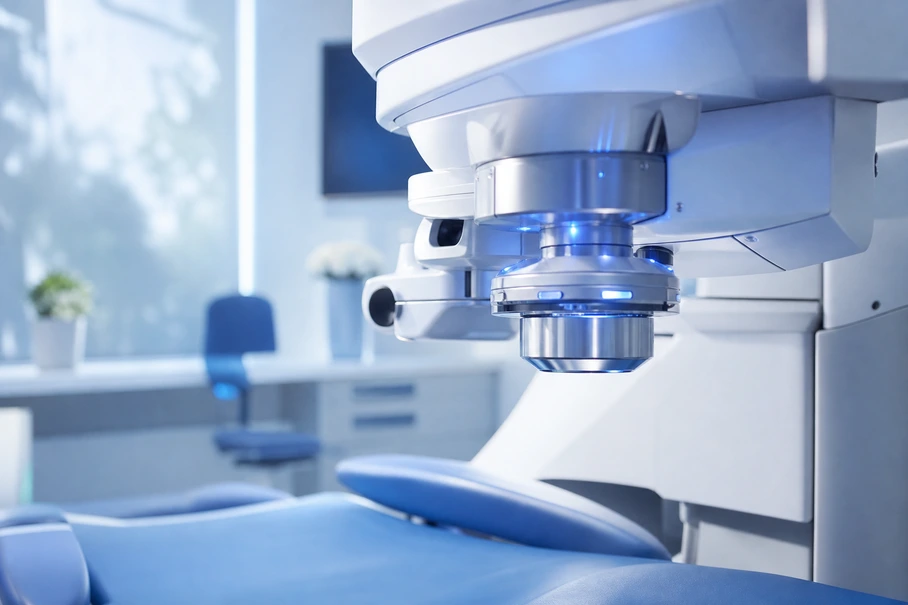
A precise laser makes a small hole in the outer edge of the iris in a few minutes, with no incision. The treatment is carried out in the clinic in Yeovil while you sit at a machine similar to the one used for an eye examination. Drops are placed in the eye first to numb it and often to control the pressure and make the iris easier to treat, and a small lens may be held against the eye to focus the laser accurately.
The laser part of the procedure usually takes only a few minutes per eye. You may notice flashes of light and a little pressure from the lens, but the treatment is generally well tolerated. Because there is no surgical wound, recovery is quick, and you can usually return home the same day after your pressure has been checked. Both eyes are often treated, either on the same visit or separately, because a narrow angle in one eye frequently means the other is at risk too. Your consultant will explain what to expect afterwards and arrange any follow-up needed to confirm the treatment has worked.
What to expect on the day of your laser iridotomy
- Drops to numb the eye and control pressure
- You sit at the laser as for an examination
- A few minutes of treatment per eye
- Home the same day with a pressure check
Laser iridotomy benefits and considerations
LPI can quickly relieve or prevent an angle-closure attack and protect your vision, and as a preventive treatment it removes a significant risk with a simple, brief procedure. For people found to have a narrow drainage angle, it offers valuable peace of mind, and for those experiencing an acute rise in pressure it can bring rapid relief alongside other emergency treatment.
There are some considerations your consultant will explain. In rare cases people notice brief glare, a line or a small blind spot after treatment, and occasionally a second application is needed if the opening is not large enough. The eye pressure is checked afterwards because it can rise briefly in some people, and mild inflammation is managed with drops. These effects are usually minor compared with the serious consequences that an untreated angle-closure attack can have for sight. As with any procedure, outcomes cannot be guaranteed, but laser iridotomy is a well-established and generally safe way to protect eyes at risk. If you have been told you have narrow angles, or if you are worried about your risk, an assessment in Yeovil will clarify whether this treatment is right for you.

Ms Brinda Shah
Consultant Ophthalmologist
Quick facts
Anaesthetic
Drops
Duration
A few minutes
Stay
Outpatient
Recovery
Same day